

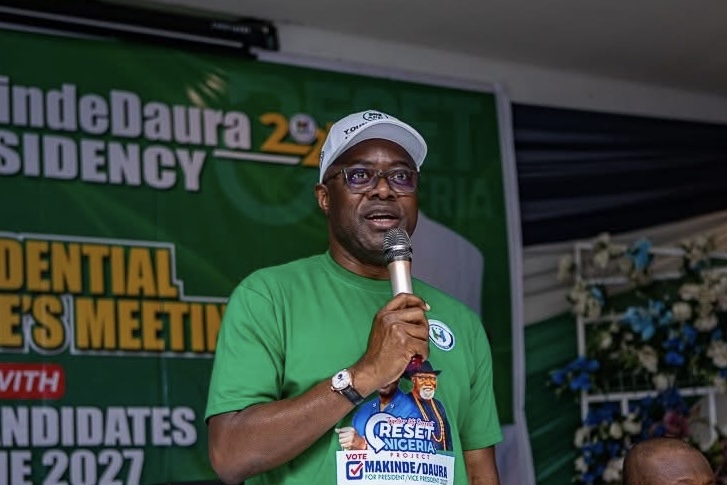
Oyo State Governor and presidential candidate of the Allied Peoples’ Movement (APM), Engr. Seyi Makinde, has called for a complete overhaul of Nigeria’s political and economic systems, arguing that the country needs a national reset rather than minor reforms to address its deep-rooted challenges.
Makinde made the declaration on Sunday during a live political programme on Jay FM in Jos, Plateau State, ahead of the his party’s campaign rally in the state scheduled for Monday, November 9.
He argued that reforms would only be effective where the positive elements of a system outweighed its weaknesses, adding that Nigeria’s current challenges required a more fundamental approach.
Using a computer system as an example, the governor said repeatedly adjusting a malfunctioning system would not resolve the problem if its underlying structure was already failing.
He maintained that shutting down and rebooting the system would provide a clearer path towards addressing the problem.
Makinde identified the economy as the foremost priority of his proposed reset agenda, arguing that economic performance should be measured by improvements in the everyday lives of Nigerians rather than favourable statistics alone.
He questioned the significance of rising foreign reserves and positive economic indicators when many citizens continued to struggle to afford food and other basic necessities.
“The economy must work for everybody,” he said, stressing that government policies should translate into improved living conditions for ordinary Nigerians.
The APM presidential candidate also called for increased investment in skills acquisition, entrepreneurship, education and local production, saying Nigeria must create an enabling environment for businesses to grow and generate employment opportunities for its expanding youth population.
Makinde calls for state police
On security, Makinde reiterated his support for decentralising the country’s security architecture through the establishment of state police.
He argued that state police would enable governors to respond more effectively to security threats within their jurisdictions, rather than relying entirely on the centralised policing structure.
The governor recalled that he had advocated for state police shortly after assuming office in 2019, when he and other stakeholders approached the administration of former President Muhammadu Buhari with the proposal.
While acknowledging concerns that state police could be abused by governors to intimidate political opponents and citizens, he maintained that appropriate constitutional and institutional safeguards could prevent such abuses.
Makinde also cited the Western Nigeria Security Network, codenamed Amotekun, as an example of how regional security arrangements could complement federal security agencies.
He said states should be allowed to establish their own police structures when they were financially and institutionally prepared to do so.
On education and youth development
On education, Makinde expressed support for the free education philosophy of the late former Premier of the Western Region, Chief Obafemi Awolowo.
He described education as a critical investment in the country’s future, recalling how Awolowo’s free education policy expanded access to learning for children from ordinary and farming families.
The governor also called for greater accountability and transparency in governance, insisting that Nigerians should be given an honest account of the country’s challenges rather than being presented with figures that do not reflect their everyday realities.
He warned that unemployment and the lack of opportunities for young people could worsen insecurity, as frustrated youths might become vulnerable to criminal activities.
He stressed the need for deliberate policies to harness Nigeria’s youthful population through education, entrepreneurship and productive economic activities.
Makinde’s comments come amid intensifying political activities ahead of the 2027 presidential election, in which he is seeking to challenge the ruling All Progressives Congress (APC) under the APM platform.
His proposed Reset Agenda centres on economic transformation, security, education and changes to Nigeria’s socio-political structure.