

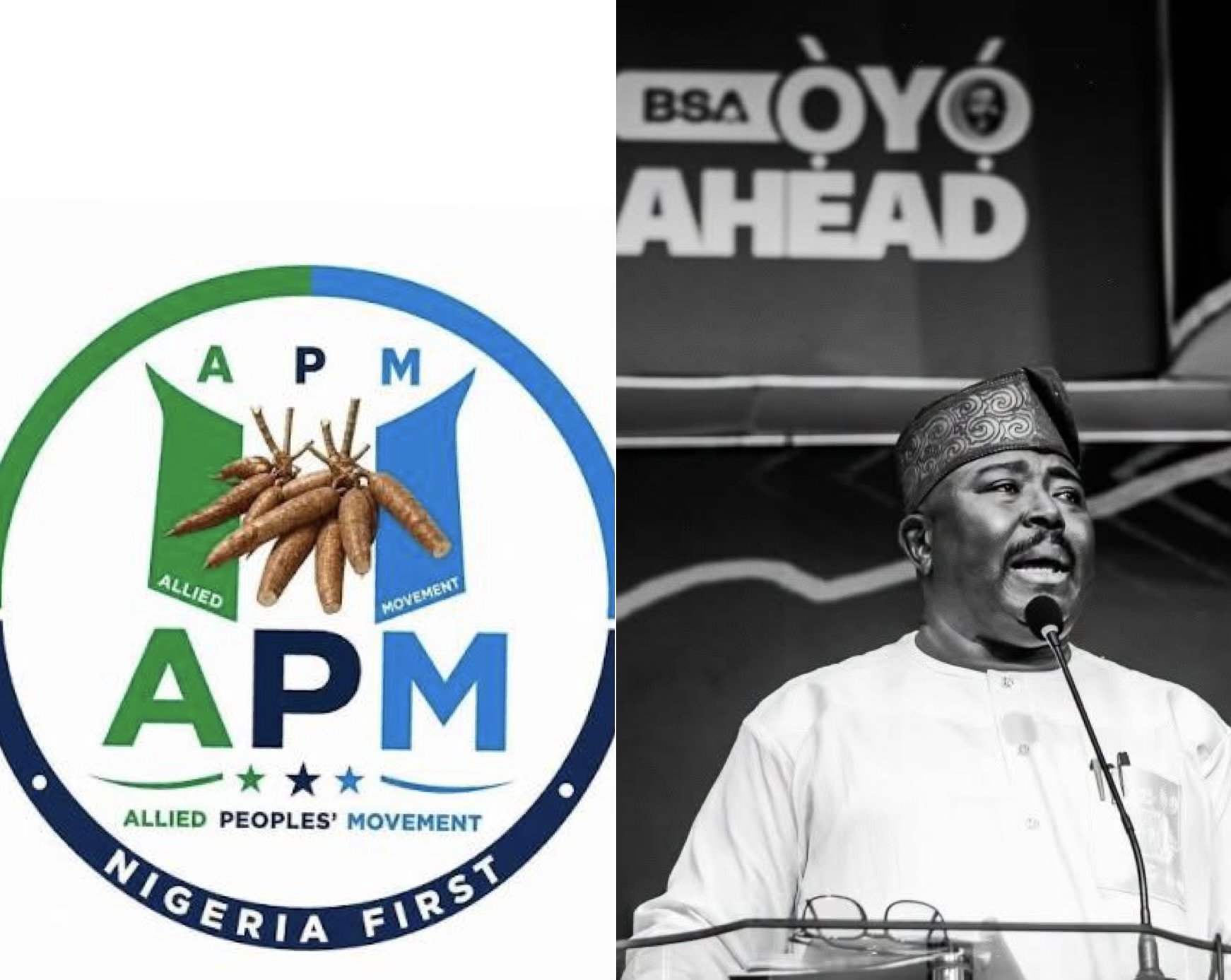
The Allied Peoples’ Movement (APM) in Oyo State has criticised the governorship manifesto of the All Progressives Congress (APC) candidate, Senator Sharafadeen Alli, describing it as lacking originality and reflecting a deficit of vision.
The party said the manifesto, tagged Oyo AHEAD, largely contained recycled political promises and proposals that were already being implemented by the administration of Governor Seyi Makinde.
This position was contained in a statement issued by the Co-Director (Media and Publicity) of the Oyo State APM Campaign Council, Dr. Sulaimon Olanrewaju.
Olanrewaju said the expectations generated by the elaborate unveiling of the manifesto were not matched by the ideas presented in the document.
He argued that rather than outlining a distinctive development agenda, the APC candidate had repackaged existing government policies and familiar campaign promises without explaining how his proposed administration would achieve better results.
Citing the proposed establishment of fully equipped primary healthcare centres in each of the state’s 351 wards, the APM spokesperson said the initiative mirrored the one-primary-healthcare-centre-per-ward policy being pursued by the Makinde administration.
He questioned the originality of presenting the same objective as a major campaign promise without explaining what would be done differently.
“If a candidate’s major healthcare proposal mirrors an existing government policy, voters are entitled to ask what exactly he intends to do differently,” Olanrewaju said.
He said similar concerns applied to other proposals in the manifesto, including the employment of more teachers, improved hospitals, prompt payment of salaries, pension reforms and economic development.
According to him, although these are important areas of governance, they do not represent fresh ideas capable of distinguishing the APC candidate’s proposed administration from the incumbent government.
The APM spokesperson also questioned why residents should consider a change of government in favour of a candidate whose major proposals, according to him, largely reflected programmes already receiving attention under the present administration.
He maintained that a credible manifesto should go beyond identifying problems and making promises to demonstrate practical and innovative approaches to addressing them.
“A serious manifesto should answer two fundamental questions. First, what is wrong with the current system? Second, what new approach will be introduced to solve the identified problems?” he said.
Olanrewaju further argued that the Oyo AHEAD document devoted considerable attention to identifying challenges but failed to provide convincing answers on the new strategies the APC candidate intended to introduce.
He also questioned the absence of what he described as transformative proposals in healthcare financing, institutional reforms, civil service modernisation and technology-driven governance.
According to him, the manifesto did not sufficiently explain how an APC-led government would fundamentally improve public service delivery or introduce a development model distinct from the approach of the current administration.
“The most significant weakness of the manifesto is conceptual. The document struggles to explain why Oyo State requires a change of government when many of its flagship proposals either replicate existing programmes or recycle long-standing political talking points,” he stated.
The APM spokesperson added that a candidate seeking to replace an incumbent administration had a responsibility to demonstrate fresh thinking and present a clearly differentiated vision for the state.
According to him, “Development is not simply about doing more of the same things. It is about discovering better ways of doing them.”
He further described the APC manifesto as being focused more on expanding existing programmes than introducing fundamental changes to governance.
Olanrewaju concluded that the document was heavy on promises but lacked the policy innovation and distinctive ideas expected of a candidate seeking to govern Oyo State.
“In the end, the document is rich in rhetoric but poor in innovation, heavy on promises but light on original thinking. And for a candidate seeking to lead one of Nigeria’s most important states, that is a serious cause for concern,” he said.